Showing posts with label Challenge. Show all posts

Friday, 22 November 2013

How To Switch Off From Technology (And How It Will Benefit Your Wellbeing)

Whether lost, listening to music, keeping in touch with friends or just desperate to Instagram your spaghetti bolognese - your smartphone or device, lightweight and fitting snuggly into your hand like a cashmere glove, is all you need to do... well... anything.

The flip-side of this new-found, much-loved convenience is, of course, addiction.

Raise your hand if you've ever scrolled through Facebook in your pitch-black bedroom until the early hours or rolled over to check your work emails/Instagram/Twitter feed first thing in the morning.

Yeah, we thought as much.

"Phones are such an intrinsic part of everything we do," says Poorna Bell, HuffPost UK Lifestyle editor speaking to HuffPost Live. "But people just don't have boundaries."

Just like any other addiction, being glued to our screens 24/7 isn't without consequences.

We spoke to Dr David Hamilton, author of How Your Mind Can Heal Your Body, to find out the benefits of switching off.

And, for those who love their phone more than their own parents, we've got some easy-to-follow tips on how to get some screen sense.



Benefits Of Switching Off
1) Gives the mind a rest so we're less stressed
Having instant and constant access to news, information, etc, means we rarely give our minds a rest. The mind and body need rest. 
We're being bombarded with information all day so we need to switch off for the sake of our own health, otherwise there's more likelihood of us getting stressed throughout the day.

2) We get better sleep quality
Sleep quality if affected by what's on our minds.
We absorb so much negative content when we read the news on a smartphone or tablet last thing at night. It affects many people's sleep quality so they end up waking up in the morning not feeling rested and refreshed.

3) It's better for our relationships
Many relationships suffer because we spend so much time online that we talk much less. Many couples even have their smartphones on the table while they are, supposedly, enjoying a romantic meal.Switching off gets us back to connecting with one another face-to-face again.

4) It can make us happier
Social network research shows that the more good quality relationships we have the happier we tend to be/ Many people develop a lot of their relationships online and not face-to-face. Some take pride in the number of 'friends' they have on Facebook, yet the amount of face-to-face time they enjoy with friends declines.
There is no substitute for face-to-face contact. We're wired to benefit from connecting with one another. Face-to-face contact is actually good for the cardiovascular system. 
Depriving ourselves of this at the expense of being online is not so healthy for us, mentally and physically.


How To Switch Off
1) Just decide
Sometimes just knowing that being switched 'on' all the time is detrimental to our mental and physical health, and also that of our relationships, is a motivating factor for people to just decide to switch off more.

2) Set some rules
It's beneficial in relationships and in families to set some rules. Without boundaries, many people just default into switching on all day and night. 
Rules can be, 'no phones or tablets at the dinner table', 'no internet in the bedroom', or 'no internet during lunch', for instance.
Sometimes, just these little rules can be a relief because many people just switch on out of boredom, so rather than rest they're bombarding themselves with more information. Rules give us an information break and let us get more from our real downtime. It feels good knowing that when you go to bed, for instance, the day's work is over because that's the rule.

3) Challenge yourself
If you're really up for it, challenge yourself to go one day a week without switching on. It might be hard at first but it will become easier if you keep it up a day a week for few weeks.

You'll then realise that it's actually not that difficult and it feels really good. It feels relaxing. It's like a little holiday - a day off.

Tuesday, 19 November 2013

9 Tips for Seizing Control Of Your Life

1. Here today, gone today – live life now! Security is an illusion, so seize life today.

2. Follow your inner compass – your intuition. When you commit to the journey, you will always end up in a place you describe and recognise as better than your starting point.
For me, intuition is a feeling I get in my stomach that a certain course of action should be pursued- normally it makes no sense from a rational perspective! For others, it is a compelling inner voice, sending them on their journey. The key is to find out how your intuition delivers. Then, once you’ve identified it, use it as your compass. The more you use it, the stronger this “core muscle” works.

3. Don’t commit your dreams and aspirations to the “normal” pros and cons approach. Remember, in the context of your dreams, knowledge will always give you enough reasons not to act.

4. Self awareness is the most important attribute a leader could develop, according to the Stanford Business School Advisory Committee, so start the journey today. Remember seeing, not solving, the problem is the ultimate challenge. When you are on the trip, you start to see!

5. Become a sponge – move towards expert status in your niche! You are a lot less than 10,000 hours away from not just getting, but creating a job! A commitment to ongoing learning is a key attribute of achievers.

6. Discover your purpose: live on flow and you’ll never truly work another day in your life! Reflect on your values and interests – this may give you an insight into your bliss.

7. Model off past success strategies. Even some of the highest achievers I have worked with around the world in companies had a disempowering inner dialogue running.
The fact is, you have already shown you have what it takes to live the dreams. As a child, you mastered the art of walking and talking by intuitively knowing that failure brought you closer to success. The Global Entrepreneurial Monitor highlights “fear of failure” as the number one obstacle for potential entrepreneurs.
“Fear” or “failure” were not an issue when you were a child. Add to that the levels of creativity you enjoyed as a child… the ability to let emotions come and go… how curious you were… and you will realise you have truly shown you have what it takes to re-engage in life.

8. Be open to the fact that everybody can be your teacher – from the most annoying person in your life at the moment to the uninhibited child. This type of thinking will open the door to teachers that will show you the way!

9. Take the first step NOW! Crossing the bridge from inaction to action may be the longest bridge in the world, but when you get to the other side, watch your life transform into one of magic and adventure! Remember, the first step can be small or big!

Tuesday, 12 November 2013

10 Ways To Become Better At Your Job Today

With a still-shaky recovery, tepid hiring and continued stagnation in many workplaces, employees have a tough time feeling inspired to extend any extra effort . But if you can improve your job performance, you will put yourself in a good position to climb up the ladder should an opportunity materialize, or to move to a totally new job, in case you hear of an opening at another company.


What’s the best way to become better at your job? We’ve run a number of stories with advice about improving job performance. After looking over those pieces and brainstorming with Forbes Leadership Editor Fred Allen, I’ve put together ten tips that should help you get ahead in your current role.

First, get organized. 

With the onslaught of email, texting, tweeting and everything else, it can be challenging to stay on top of your workload. We ran this story about conquering your email inbox, which recommends a system of prioritizing urgent items, dealing with short requests quickly, deleting junk and putting less pressing matters on a to-do list. One more tip: Consider imposing some discipline on email interruptions. Check your inbox once a half hour or once an hour, to give yourself time to complete tasks that require concentration.

Second, stop trying to multi-task. 
In 2009, a group of Stanford researchers released a study that showed how people who do heavy multitasking, keeping up several email conversations at once while texting, jumping from one website to the next and trying to work at the same time, do not pay attention as well as those who maintain a more streamlined work flow.

Third, put yourself in the mindset of your boss. 
We’ve run several stories about dealing with difficult supervisors. The most effective strategy: Empathize, and discover your boss’s style, so that you can imagine what he or she is looking for in an employee. We ran this piece about dealing with a younger supervisor, this story about a series of questions you can ask your boss, which will help you get to know her (what was her previous job? what are her career aspirations?), this story about dealing with a lousy manager (set an agenda, don’t yell back), and this piece about managing up a difficult boss (treat him like a difficult client). The overarching lesson: figure out your boss’s style and orientation and try to stay one step ahead.

Fourth, forge strong relationships with colleagues outside your immediate area of responsibility. 
In his best-selling book Getting More: How To Negotiate to Achieve Your Goals in the Real World, Wharton Business School professor Stuart Diamond notes that “companies, even small ones, can be very political places.” Diamond recommends allying with people who can help you, including employees who have been there a long time and who may be overlooked by others, those who work in human resources, staffers in the information technology department, even security guards and cleaning staff who have probably absorbed much more about your firm than you realize. Diamond calls it “building your own coalition.”

Fifth, focus on listening. 
Listen to your boss of course, but also pay close attention to your colleagues and subordinates. At work we often feel like we have to perform by doing verbal gymnastics, but listening closely to what others say can be even more useful and can garner more appreciation from co-workers.

Sixth, try getting in early. 
Even 15 minutes can make a difference. If you can swing an early arrival, you will get a step ahead of the day’s tasks. You can even reward yourself later with a longer lunch break or a departure for home that comes earlier than usual.

Seventh, make sure you give yourself genuine down time. 
We ran a piece on the importance of vacation. That means time away from the office when you don’t check work email or let yourself think about the next project. It can give you a sense of control, of purpose, it can shake up your perception of time, offer the space to expand cultural horizons and allow the kind of relaxed break everyone needs to refuel.

Eighth, once you’ve refueled, aim for clarity and precision in everything you do at work.
If an email won’t convey the subtlety of your decision to push for a colleague’s ouster, then pick up the phone or visit in person.

Ninth, do plenty of research and preparation before you undertake any task.
Don’t take up your boss’s time before you’ve performed plenty of legwork. Prior to a meeting, rehearse your strategies and objectives.

Tenth, try some humility.
Most career advice seems to encourage relentless self-promotion. But Orville Pierson, author of The Unwritten Rules of the Highly Effective Job Search, says it’s better to avoid strings of hyped-up adjectives and instead to describe your accomplishments simply, without embellishment.

Monday, 11 November 2013

Scared? 5 Tips For Using Fear As Fuel


Recently I have been thinking about fear and how it relates to behavior. We typically avoid things that scare us, which, of course, makes perfect sense. We have evolved an instinctive fear of threats and this avoidance behavior is ingrained in us as a way to protect us from harm. However, as is often the case, in the modern world our natural biological defenses can unnecessarily hold us back from deep fulfillment. Many times, that which we instinctively fear can actually be harmless, or even a blessing.

But in order to assess a fear I have found that you have to unpackage it first, to really consider its components and sources, and to figure out whether it’s worth ignoring. By way of example, I recently experienced some fear in dating a man who is unable to walk. When I really thought about my reaction I realized that it was simply a fear of the unknown.


Fear can be something that keeps you from moving forward, from being all that you can be. When you forgo an opportunity, remember, it just might have turned out to be something life changing, or something that you would have loved — you just don’t know. The key is determining whether your fear is borne out of a real danger, or if it is simply the result of apprehension in facing the unknown. In business growth, it’s most likely the latter, not the former. Having a strategy to face fear and move through it can be a huge tool for success. Here are 5 suggestions that may help you get started:


  1. Think about your fear, dissect it, and try to determine if it’s a fear of the unknown or a real danger.
  2. Learn about it. Do some research. What do other people say about this fear when they experience it? What are the pros and cons of tackling this fear? Let’s say it’s public speaking. What would the impact be on your career or life by focusing on this?
  3. Ask a lot of questions. Find other people that have tackled whatever you have fear about and ask them how they approached it. What are the rules of the road? What are some tips, tricks etc.?
  4. Find someone to do it with you. When we resist doing something it’s easy to let ourselves down. It’s much more difficult to let someone else down. When I am feeling less motivated to workout, I make a workout date. There is no question whether or not I will show up — I will.
  5. Recall how it feels once you have tried conquering your fear. Most people will say that facing a fear is one of exhilaration. I know from personal experience that the things or activities that I fear and conquer end up being some of my proudest moments.
Some fears you know and can plan for. Others just pop up out of nowhere.Use the New Year as a reason to stretch yourself, to attempt a new marketing strategy, to try a new activity that scares you.

http://www.care2.com/greenliving/scared-5-tips-for-using-fear-as-fuel.html?page=1

Saturday, 26 October 2013

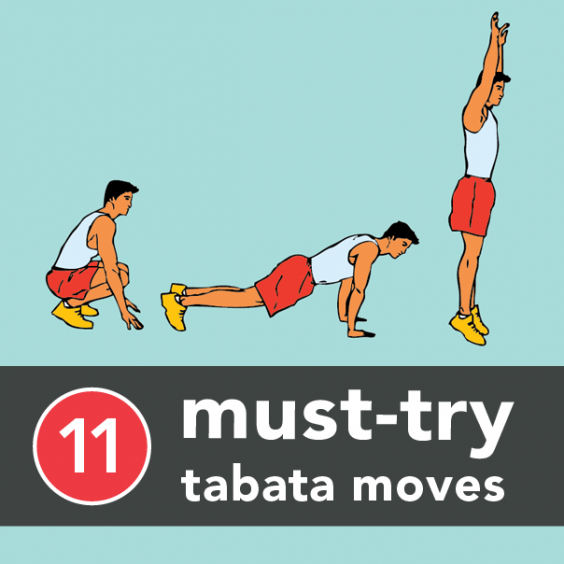
11 Must-Try Moves To Get Started With Tabata


Illustrations by Printable Workouts for Greatist


After 10 seconds, I was gasping for breath, sweaty, and definitely convinced that four minutes of Tabata intervals counts as a real workout. Greatist’s Chief Research Officer David Tao was helping me “research” Tabata protocol, and after a round each of burpees, medicine ball clean and presses, and squats, I was feeling the burn (and then some, given how sore I was for the next three days).


TA-BAT-ER UP — THE NEED-TO-KNOW
Tabata Protocol is a system of short, high-intensity intervals developed by Japanese professor Dr. Izumi Tabata to train Olympic speed skaters. Grab a stopwatch, because this workout method is all about timing. The basic formula for Tabata training is 20 seconds of work followed by 10 seconds of rest, repeated between six and eight times (between three and four minutes, total). No cheating — the 20/10 ratio has been shown to work both aerobic and anaerobic metabolic pathways harder and more effectively than longer bouts of exercise.

TABATA BING, TABATA BOOM! — YOUR ACTION PLAN
Because this exercise strategy is more of a formula than a specific workout, the possibilities for Tabata are pretty darn flexible. Love bodyweight exercises? Do a set of push-ups. Feeling a dip in the pool? Pull on that swim cap and do some freestyle intervals. As with any workout regimen (and especially a high-intensity one like Tabata intervals), consult with a trainer beforehand to learn the correct technique. When going all-out, proper form can be the difference between a ticket to the gun show and a ticket to the physical therapist’s office.

Greatist Experts Ilen Bell and Kelvin Gary each picked one or two of the best moves for each area of the body, with added weights and using bodyweight alone. Each of these four-minute wonders packs a serious punch (just ask my quads after a round of squats), so start with just one or two exercises per workout. Feel free to rest for a few minutes in between the 4-minute bouts, or go back-to-back for an added challenge.

THE MOVESFull Body

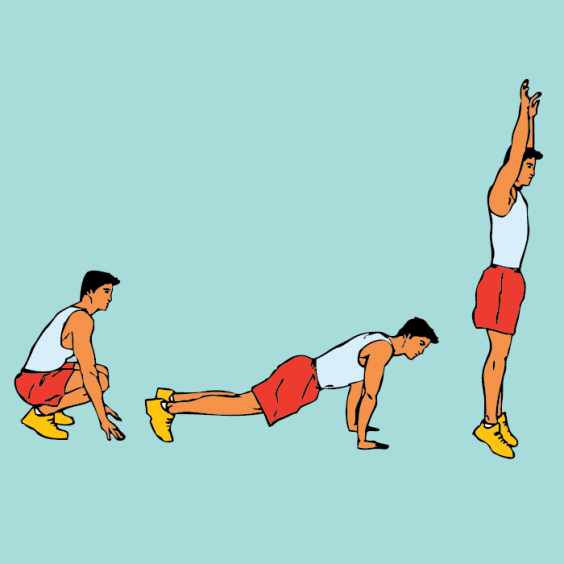
1. Burpee: Start standing, then crouch to a low squat position with the hands on the floor. Then, kick feet back to a plank, then down into the bottom of a push-up. Push off the ground and quickly return to the squat position. Last step? Jump up as high as possible before squatting down again and jumping back into the next push-up.


Lower Body
2. Jump squat: Stand with the feet hip-width apart, toes pointing forward. Sit back into a squat (hips below parallel, please!) then drive the whole body up through the heels, shifting weight onto the balls of the feet as you lift off. Be sure to land on the balls of the feet and immediately bend the knees into a full squat. Make sure the knees aren’t wobbling side to side while squatting or landing from a jump.

3. Lunge jump: Start standing with the feet together and lunge the right foot forward, bending the knee about 90-degrees and keeping the torso vertical. Then,jump straight up, and while in the air, switch legs and land in a lunge with the left foot forward.

4. Dumbbell front squat: Hold a dumbbell at the sternum (the center of the chest) and do a basic front squat. Place feet a little wider than shoulder-width apart, hips stacked over knees, knees over ankles. Inhale and unlock the hips, bringing them back as the knees begin to bend. Keep the chest and shoulders upright, and continue until the hips are slightly less than 90 degrees from the ground. On the way back up, engage the core and drive through the heels to return to standing.


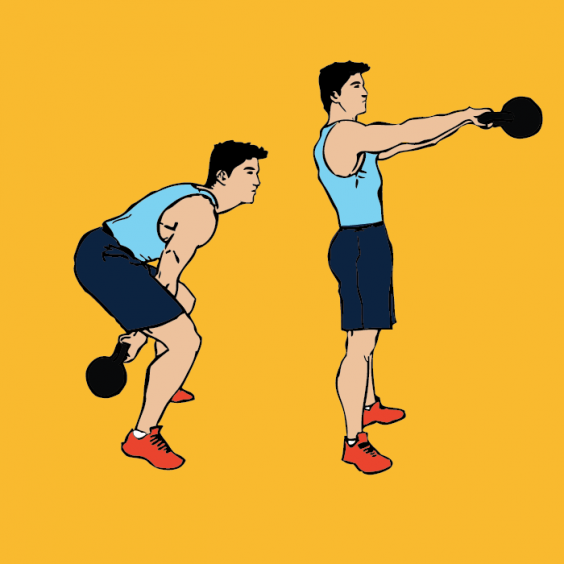
5. Kettlebell swing: Stand up straight, with feet a bit wider than hip-distance apart. Grab hold of the kettlebell with both hands, keeping the palms face down and arms in front of the body. Keep the knees slightly bent and drive the hips and bell back (it’s not a squat, so the knees shouldn’t have to bend that much), lowering the body just a bit to an athletic stance. In one fluid motion, explosively drive the hips forward while swinging the kettlebell, engaging the glutes and core. 

Upper Body
6. Push-up: Get into a plank position with hands planted a little bit wider than shoulder width apart. Keep the elbows close to the body throughout the movement. Ground the toes into the floor and engage the abs and back so the body is neutral.Lower the body in one straight line until the chest touches the floor. Keeping the core engaged, exhale, and push back to the start position.

7. Overhead neutral grip press: Stand with the feet shoulder-width apart core tight. Raise the dumbbell, kettlebell, or barbell up to the shoulders with palms facing each other and the elbows below the wrists. Press the weights upward until the arms are fully extended overhead, and then lower back to the shoulders.
Cardio

8. Sprints: To get extra speedy, make sure form fits function. Hold the correct posture, with eyes up, chest tall, shoulders relaxed, and arms swinging up and down with the elbows at 45-degree angles.

9. Stationary bike or rower: Hopping on the bike for a quick spin is pretty self-explanatory, but the indoor rower is a bit trickier. First, strap feet into the foot stretchers, sit up tall, and grab the handle. Roll forward until legs are completely bent and arms are reaching forward. From this starting position (called the “catch”), explosively drive the legs back. When the legs are nearly extended, swing the torso back and pull the arms in so the handle is almost touching the rib cage. From here (aka the “finish”) recover by stretching the arms straight out, returning the upper body to a straight, vertical position, and bending the legs back to the catch.
Core


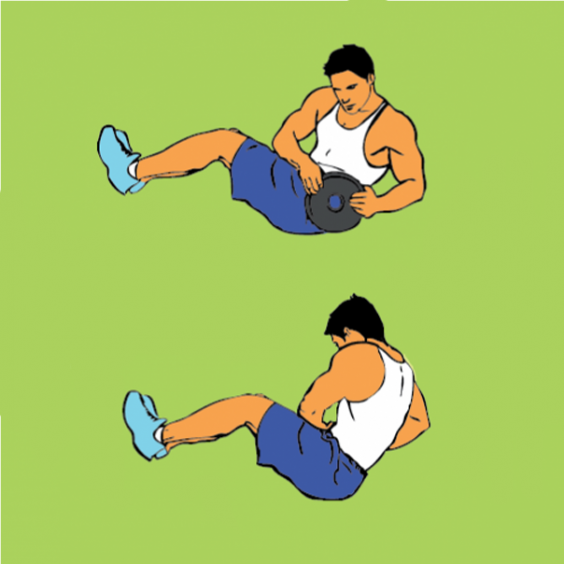
10. Russian twist: Sit on the floor with the knees bent and feet together and lifted a few inches off the floor. With the back at a 45-degree angle from the ground, move the arms from one side to another in a twisting motion. Go super slow, twisting the shoulders completely from side to side.

11. Ski abs: Start in pushup position with hands under the shoulders and core engaged. Jump the feet to the left side of the body, as close to the upper torso as possible. Jump the legs back to a straight plank position and repeat on the right side.


With the exception of the weighted movements, most of these can be performed anywhere, any time. All you need is a set of comfy clothes and a serious work ethic. To make keeping track of the time easier, consider downloading a Tabata timer app. Again, consider meeting with a trainer to go over correct form (even if you’ve previously done these moves) before starting a Tabata fitness regimen to prevent injury. 

http://greatist.com/fitness/best-tabata-moves

Monday, 2 September 2013

12 Body Language Tips For Career Success

When properly used, body language can be your key to greater success. It can help you develop positive business relationships, influence and motivate the people who report to you, improve productivity, bond with members of your team, and present your ideas with more impact. Here are a dozen tips for using body language to project confidence, credibility, and your personal brand of charisma:


1. Stand tall and take up space. 
Power, status, and confidence are nonverbally displayed through the use of height and space. Keeping your posture erect, your shoulders back, and your head held high makes you look sure of yourself.


2. Widen your stance. 
When you stand with your feet close together, you can seem hesitant or unsure of what you are saying. But when you widen your stance, relax your knees and center your weight in your lower body, you look more “solid” and confident.


3. Lower your vocal pitch. 
In the workplace, the quality of your voice can be a deciding factor in how you are perceived. Speakers with higher-pitched voices are judged to be less empathic, less powerful and more nervous than speakers with lower pitched voices. One easy technique I learned from a speech therapist was to put your lips together and say “Um hum, um hum, um hum.” Doing so relaxes your voice into its optimal pitch. This is especially helpful before you get on an important phone call – where the sound of your voice is so critical.


4. Try Power Priming. 
To display confidence and be perceived as upbeat and positive, think of a past success that fills you with pride and confidence.


5. Strike a Power Pose. 


6. Maintain positive eye contact.
You may be an introvert, you may be shy, or your cultural background may have taught you that extended eye contact with a superior is not appropriate, but businesspeople from the U.S., Europe, Australia (and many other parts of the world), will expect you to maintain eye contact 50-60% of the time. Here’s a simple technique to improve eye contact: Whenever you greet a business colleague, look into his or her eyes long enough to notice what color they are.


7. Talk with your hands. 
Brain imaging has shown that a region called Broca’s area, which is important for speech production, is active not only when we’re talking, but also when we wave our hands. Since gesture is integrally linked to speech, gesturing as you talk can actually power up your thinking. Whenever I encourage clients to incorporate gestures into their deliveries, I find that their verbal content improves, their speech is less hesitant, and their use of fillers (“ums” and “uhs”) decreases. Experiment with this and you’ll find that the physical act of gesturing helps you form clearer thoughts and speak in tighter sentences with more declarative language.


8. Use open gestures. 
Keeping your movements relaxed, using open arm gestures, and showing the palms of your hands — the ultimate “see, I have nothing to hide” gesture — are silent signals of credibility and candor. Individuals with open gestures are perceived more positively and are more persuasive than those with closed gestures (arms crossed, hands hidden or held close to the body, etc.) Also, if you hold your arms at waist level, and gesture within that plane, most audiences will perceive you as assured and credible.


9. Try a steeple. 
You see lecturers, politicians and executives use this hand gesture when they are quite certain about a point they are making. This power signal is where your hands make a “steeple” — where the tips of your fingers touch, but the palms are separated. When you want to project conviction and sincerity about a point you’re making, try steepling.


10. Reduce nervous gestures. 
When we’re nervous or stressed, we all pacify with some form of self-touching, nonverbal behavior: We rub our hands together, bounce our feet, drum our fingers on the desk, play with our jewelry, twirl our hair, fidget — and when we do any of these things, we immediately rob our statements of credibility. If you catch yourself indulging in any of these behaviors, take a deep breath and steady yourself by placing your feet firmly on the floor and your hands palm down in your lap, on the desk or on the conference table. Stillness sends a message that you’re calm and confident.


11. Smile. 
Smiles have a powerful effect on us. The human brain prefers happy faces, and we can spot a smile at 300 feet – the length of a football field. Smiling not only stimulates your own sense of well being it also tells those around you that you are approachable and trustworthy.


12. Perfect your handshake. 
Since touch is the most powerful and primitive nonverbal cue, it’s worth devoting time to cultivating a great handshake. The right handshake can give you instant credibility and the wrong one can cost you the job or the contract. So, no “dead fish” or “bone-crusher” grips, please. The first makes you appear to be a wimp and the second signals that you are a bully.

Handshake behavior has cultural variations, but the ideal handshake in North America means facing the other person squarely, making firm palm to palm contact with the web of your hand (the skin between the thumb and first finger) touching the web of the other person’s hand, and matching hand pressure as closely as possible without compromising your own idea of a proper professional grip.

http://www.forbes.com/sites/carolkinseygoman/2013/08/21/12-body-language-tips-for-career-success/

Monday, 19 August 2013

Changing Jobs? Plan Your Exit Strategy Well

Having an exit strategy can help you know the right time to seek a job change

As many business people may tell you: Having a viable exit strategy is a must for any successful project. Jobs are not any different. You always should know what you’re getting yourself into, what you want to achieve throughout your employment and what you will be able to do afterward – whether your exit is voluntary or not. At the end of the day your experience with each job should be a success story that can take you to the next level.

People who pursue such a plan often set goals for each and every job. These goals help them stay focused, enjoy their employment and be able to advance to a better position at the end.

Not to be confused with a lack of commitment, having an exit strategy can help you know the right time to seek a job change. Very often, people lured by a financial boost or what appears to be a better title, may leave their jobs prematurely. Sticking with each job for the right – often long – haul can help you make the best of each experience. When you make the decision to quit, then you’re sure you’re making the right move.

Here is how you should consider your exit strategy through each phase of employment.

Job hunting
Although this may sound unrealistic in view of the still-tight job market, you should be cautious in accepting a job offer that isn’t a logical step on your career path. Such jobs can turn into obstacles for advancement. Not taking the job is usually better and less damaging than taking it for a short period. Think of the time and disruption involved with a short-term job experience. Not only your exit may not be as smooth as you would like it to be, your next step may become even more complicated. That is why you should focus on making sure that you pick a job that you can stay with and it will lead you to a better position once you go back in the market.

Employment
This is the core length of your work, and it can be several years. As mentioned, having an exit plan doesn’t mean that you won’t be full-heartedly investing in your job. Instead, you should keep your eye on your end goals in terms of achievement and advancement. This is a personal interest that shouldn’t conflict with your employer’s interest. Your enthusiasm may be highly regarded and appreciated. To position yourself for the next job, make sure that your knowledge and skills are always up-to-date. Keep your eyes open for training opportunities, webinars, certifications, etc. Most important, make sure that while you settle in nicely in your office routine, you don’t lose touch with what is going on around you. Having solid industry connections and being an active member in trade organizations and networks can help you stay abreast of your profession changes and market trends.

Near the end
Many people consider changing jobs out of boredom. While this is understandable, it is not justified. You may be bored of your job for the simple reason of not making the best out of it. If you change your attitude and see the potential areas that can be developed to shine, you may find yourself enjoying your current job and you will be able to make the decision to move based on more valid reasons. Apart from a layoff that may be unpredictable, the time for a voluntary exit should be set when your goals are achieved. These are typically long-term goals like closing several big projects, bringing in a certain volume of business, etc. Your goals can be a moving target and you may want to challenge yourself in achieving even a higher goal. An exit also can be through pursuing a promotion with your current employer.

The exit
Now that you’re at the exit, it is time to review how you’ve fared compared to your initial plan. Have you acquired the knowledge and the skills that help you with your next job? Are you confident that you can apply for more senior positions or with more quality employers as a result? Have you developed the connections within the industry that can help you place a job easier? If your answers are yes, then you’ve achieved your goals and benefited from having an exit plan from start to end.


Finding the exit

- Check a job leads in the right direction

- Set goals to advance

- Make sure you exit at the right time

- R.O.


http://gulfnews.com/business/opinion/changing-jobs-plan-your-exit-strategy-well-1.1218415

Friday, 31 May 2013

Time for a Personal Mid-Year Review: This Is How! (What We Can Learn From Business)

"Life can only be understood backwards; but it must be lived forwards." -- Søren Kierkegaard

This week, the first companies announced their half-year results for 2013. Referring to the goals they had set themselves at the beginning of the year, they took a moment to reflect on their performance to date, in order to make adjustments where necessary, for the rest of the year.

Although this mid-year review in business is mainly driven by the capitalist system we live in, it is a very wise thing to do because growth can only come from understanding, and understanding always comes from reflecting on what has happened; it can indeed, like Danish philosopher Søren Kierkegaard said: "only be understood backwards."

So, if we wish to keep growing and developing in the right direction ourselves, and if we wish to achieve the goals we had set ourselves in our New Year's resolutions, writing a personal mid-year review is a great tool to do so!


This is how!

1. Write down the goals you had set yourself at the beginning of the year.
It is good to "categorize" your goals. For example: health, family/social life, work, the balance between the both, personal development and living sustainable.

2. Write down how you have "performed" in these categories.
Next to each goal, simply write down whether you have already succeeded or if you still need to work on it.


3. For each category, write down one or two of the biggest "challenges" you have had as well as one or two things that helped you to do really well.
This helps you to determine what "qualities" you can deploy to achieve the goals that are still on the "to do" list.

4. Are there any new goals you would like to set for yourself?
In the category "health" and "family life" I have added for example: "Making more home-cooked meals." In the category "personal development," I have added: "Being more patient" and "enroll in a course." And in the category "living sustainable," "don't keep the water running when I don't use it."

5. Write down in maximum two sentences how you wish to achieve the goals that are "open" on your list.
Limiting yourself to maximum two sentences will help you to get right to the point!

6. Write yourself and others a wish to succeed!
It is so very important to send yourself and others the strength to accomplish what you and they have wished for; it opens your heart to yourself and others, and this is in the end the key to whatever growth you wish for.

Having said that, there is also no other way for me to end this blog then by sending a wish myself: "May I, and all of you, be able to find the strength, wisdom and determination to overcome all challenges and to reach the goals that have been set!" Cheers to "live life forward!"


Wednesday, 29 May 2013

Ten Top Personal Development Tips

Personal development is a very broad topic and can encompass anything that involves your growth as a person. It means following a course of continual growth and striving to reach your full potential. When you become a little better in some way than you were the day prior, your life and your circumstances will continuously improve. Personal development is typically achieved by first looking within oneself, altering your thinking, and ultimately changing your behavior as a result.

Since each of us is a unique individual our paths will vary. That having been said, below you will find 10 of the most helpful suggestions for improving one's self.
Enjoy the journey!


1. Don't Let Anything Stop You
Never quit, never give up. 
Throughout your journey, there will be ups and downs. It is a given that there will be slow points and setbacks. These things will occur. In those moments of doubt or despair, DO NOT GIVE UP. Know in your heart that no matter how difficult things may become, no matter how low you may feel, ultimately there is nothing that will stop you. Life can throw whatever it wants at you and you will not quit, you will not falter until you win.

Keep in mind that personal development is a lifelong journey. There is no ending. It's all about the experiences and lessons learned.

So since there really is no finish line, make sure you enjoy the ride!


2. Follow Your Passion
Do what makes you happy. 
This is something that we have very, very backwards. Most of us chase money. While money is certainly not a bad thing, money by itself does not bring joy. Money can buy stuff. Stuff can provide temporary fun. But stuff doesn't bring true joy.

Follow your heart. Do what you love. The amazing thing about this is that when you do something that you're passionate about, you'll be successful at it. You'll put it tons of hard work and many, many extra hours and it will never feel like "work" because you're having fun. And as a result, the money will follow.


3. Challenge Yourself
Your goals should be just out of reach. Always challenge yourself. Growth comes as a result of adversity. If everything were easy, we would never change or grow. Your goals should not be impossible, but they should be challenging. Push yourself beyond what you perceive to be your current limitations. Explore new territory. Try out different things that you've never done before. Do something that you're afraid of.

Greatness comes as a result of having to dig deep and discover something that you didn't realize you already had inside of you.


4. Conquer Yourself
The only true obstacles in life are self-imposed. We will always have unforeseen things occur. Roadblocks will come up from time to time. You'll be right on the verge of accomplishing something only to have the rug yanked out from under you at the last moment. Murphy's Law strikes again.
While we cannot always control what happens to us, the one thing we can control is how we react to it. The only true obstacles we have in life are self-imposed. Our true obstacles lie within. If you can conquer yourself, nothing can stop you. As the saying goes, whether you think you can or you can't--you're right


5. Visualize Your Goals

Picture yourself where you want to be. As author Rhonda Byrne taught us in the best selling book "The Secret", what you intend will come to be.

Discover your true intention and make certain your goals are in alignment. Picture yourself achieving this goal. Close your eyes and imagine how it feels to accomplish this goal. Truly allow yourself to experience the emotions associated with the experience. Feel as though it has already happened.

Go through this visualization process daily until your goal has been achieved. Many successful people believe in the power of visualization and have used it throughout their lives to achieve great things.


6. Personal Responsibility

Avoid the blame game. This may seem counter-intuitive, but accept fault for everything that goes wrong in your life. No, that's not a typo. As hard as this may be to face, the reality is YOU are responsible for where you currently are in life. You have created your circumstances. Your choices and actions have gotten you to where you are today.

There is a great freedom that comes as a result of accepting personal responsibility. As soon as you stop blaming others, you are no longer a victim. You're free to change things in your life for the better. Once you come to the realization that you are where you are as a result of your decisions, this puts you in the driver's seat for the future.


7. Be a Student of Change
Embrace change. 
Our world is constantly evolving and today at a much more rapid pace than in the past. Change is difficult. It's easier to find a comfort zone and stay there. The problem with this, however, is that the world is going to keep moving forward without you.

Things are changing, regardless of how you feel about it. By becoming a student of change, you'll be able to adapt and stay ahead of the curve. Besides, change is good. If it weren't for change, I'd be sitting in a cave right now. 
So learn to welcome change. In today's fast paced world, it's the only constant.


8. Read, Read, Read
Learn from others. You know the best way to become successful? Do what successful people do. While making mistakes is not something to be avoided (this is how we learn), you can certainly speed up your self development process by reading about the mistakes others have made and learn the lessons therein.

Make it your personal goal to read at least a book per month. I recommend reading anything written by Seth Godin or Robert Kiyosaki. For a list of further recommended reading books to help open your mind, click here:


9. Make It Manageable
Break big tasks down into small steps. 
Sometimes large goals or projects can seem unattainable. For example, "repair my credit" may seem like a daunting task. Where would you even begin?
One step at a time

Take large items on your to do list and break them down into small, manageable steps. Using the example above, on Monday take out your credit report and highlight all errors that need to be addressed. On Tuesday contact each creditor and ask that the item be fixed/removed. On Wednesday set up automated payments for your bills so that you develop prompt payment history. And the list goes on.

Take it one step at a time and suddenly that giant mountain doesn't seem so imposing.


10. Sense of Urgency - Avoid Procrastination at All Costs!
Start TODAY! There is no such thing as the perfect time. The amazing thing is that 100% of people that begin something NOW all get started. Those that wait until tomorrow? Not so much.

For whatever reason, the longer we wait the less likely we will take action. It's just human nature. As time passes, things tend to lose importance in our minds. Sense of urgency will help you get things accomplished, and get them accomplished in a timely fashion.

If it's important, do it now. While the first step is always the most difficult, every step afterwards becomes progressively easier.

http://www.squidoo.com/personal-and-professional-development